The 2025 Playbook for the Future of Money in Asia

Asia’s payments landscape isn’t just evolving—it’s exploding. By 2025, the region will redefine how money moves, fueled by technological innovation, regulatory ambition, and a hunger for financial inclusion. Forget what you know about payments today; the future is being written in real-time, and it’s happening here.
Let’s break down the seismic shifts reshaping the industry. Strap in—this isn’t just a trend report; it’s a roadmap for where the money is headed.
Trend #1: Democratisation of Payments – Small Businesses Take Center Stage
Imagine a street vendor in Jakarta or a rural artisan in India accepting digital payments with near-zero friction. This isn’t a distant dream—it’s 2025’s reality. Asia is pioneering ultra-low-cost payment systems powered by QR codes and lightweight apps, bypassing traditional card networks.
The numbers speak for themselves. A 2023 report by Bain & Company, Temasek, and Google found that digital payments now account for over 50% of transactions in the region, dethroning cash as king. India’s Unified Payments Interface (UPI) is a standout, processing 10 billion transactions monthly as of 2023, with a significant share from small businesses and rural areas.
The secret? QR codes and app-based solutions that require no hardware investment, making them ideal for micro-merchants. China’s Alipay and WeChat Pay have already proven the model’s scalability, with over 80% of merchants in China accepting QR based payments.
The question isn’t if mass inclusion will happen—it’s how fast. With India’s UPI, China’s Alipay, and Southeast Asia’s GrabPay and GoPay driving adoption, the answer is: faster than you think.
Why This Matters:
This shift isn’t just about convenience—it’s economic empowerment. For small businesses, it means faster cash flow, access to credit, and a seat at the digital economy table. For governments, it’s a win-win: lower cash-handling costs and a more transparent financial system.
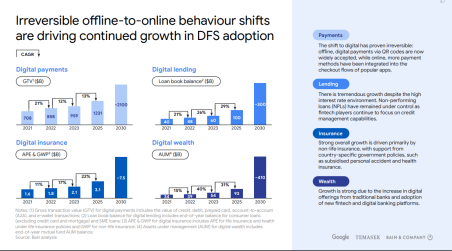
Source: Google, Temasek and Bain & Company Report
Trend #2: Mobile Takes Over – Cash and Paper Are Dead Weight
Branches are fading into the background. Cash? It’s increasingly becoming a secondary option. Mobile devices are now the primary channel for financial interactions.
According to Capgemini’s World Payments Report 2025, non-cash transaction volumes in Asia-Pacific surged to 1,411 billion in 2023 and are expected to hit 2,838 billion by 2028, growing at 20% YoY—outpacing Europe (16%) and North America (6%).
This shift isn’t just about convenience—it’s about cost efficiency and meeting customer expectations. Governments and fintechs are working hand-in-hand to reduce reliance on cash and paper. E-commerce growth is a key driver, particularly in Asia, where digital adoption is booming.
Trend #3: Smartphones as the New Payment Hubs
The traditional POS terminal is no longer the centerpiece of retail transactions. Software-driven solutions are turning smartphones into versatile payment terminals.
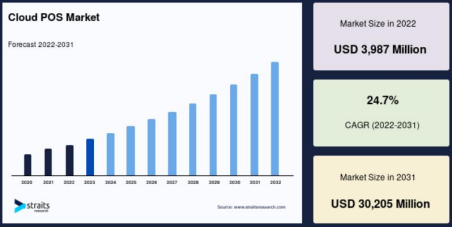
The global cloud POS market, valued at 4.97 billion in 2023 is projected to reach 36.25 billion by 2032, growing at a 24.7% CAGR, according to Straits Research. These systems enhance productivity, streamline operations, and slash costs, making them ideal for SMEs.
By integrating seamlessly with inventory management, accounting, and customer loyalty programs, these systems offer a level of flexibility and efficiency that traditional POS setups simply can’t match. In Asia, where SMEs dominate, this shift is transformative, enabling businesses to compete in a digital-first economy.
Trend #4: AI-Powered Fraud Detection
As digital payments surge, so does fraud. Juniper Research projects global merchant losses from online payment fraud to exceed 362 billion between 2023 and 2028,with 91 billion in 2028 alone.
AI and machine learning are stepping in, analyzing thousands of data points in real-time to identify subtle patterns and reduce false positives by up to 80%. These systems adapt to seasonal fluctuations, detect emerging trends, and scale across markets, providing robust protection for payment providers expanding into new territories or launching innovative products.
Trend #5: Real-Time Payments – The New Normal
Asia is leading the global real-time payments (RTP) race, with India, Indonesia, and Malaysia at the forefront.
India dominates, processing 129.3 billion real-time transactions in 2023—nearly half the global total. Instant payments now account for 84% of all transactions in the country. Indonesia isn’t far behind, with 55% of consumers regularly using RTP systems, while its network grows at an 81.9% CAGR. In Malaysia, PayNet, the nation’s core RTP infrastructure, saw transactions worth $1.9 billion in 2023, growing at 26% YoY.
The drivers? Surging smartphone adoption, high-speed internet, and the need for faster, cheaper, and more secure payments. By 2025, real-time payments won’t just be an option—they’ll be the norm.
Trend #6: Cross-Border Payments – Mobile Rails Take the Wheel
Cross-border payments are getting a major upgrade. Systems like India’s UPI and Singapore’s PayNow enable instant, low-cost transfers, while CBDC pilots like Thailand and Hong Kong’s mBridge explore blockchain-based settlements.
Interoperable QR codes and embedded finance are streamlining transactions, offering frictionless experiences for businesses and consumers. By 2025, cross-border payments in Asia will be defined by speed, affordability, and accessibility, unlocking new opportunities for regional trade and economic growth.
Trend #7: Embedded Finance – The Silent Disruptor
Embedded finance is a $104.8 billion market in 2024, growing at a 23.3% CAGR, according to Global Markets Insight. By 2034, it will be everywhere, integrating financial services into everyday platforms.
From instant loans at checkout to insurance in travel apps, embedded finance is transforming how we pay, borrow, and save—without ever leaving the apps we use daily.
The Bottom Line
Asia is poised to become the world’s largest payments revenue pool, driven by a potent combination of technological innovation, regulatory support, and rapid digital adoption. This trend will be amplified by the region’s four major economic powerhouses: China, India, Japan, and ASEAN. Together, these markets are not only reshaping the payments landscape but also setting the stage for Asia to dominate the global financial ecosystem. In 2025, Vedas Asia expects the region’s influence in the payment landscape will be undeniable, redefining how money moves and creating unprecedented opportunities for businesses, consumers, and economies alike.