Capital, community and conviction: Inside Vedas Group Asia’s family office and family business strategy
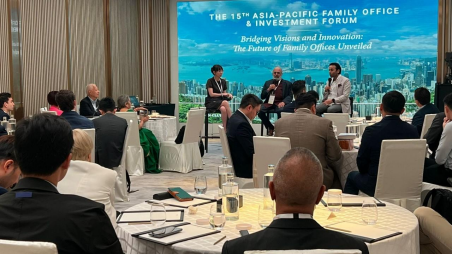
At a recent family office summit in Hong Kong, the principals of Vedas Group Asia, Sridhar Chityala and Shreyas Slater Chityala offered a rare look into how their family office and family business operate across private investments, philanthropic capital, and long-term intergenerational collaboration.
Based in Singapore with a footprint across ASEAN and the United States, the family office has built a dual-track model: a disciplined investment strategy grounded in capital preservation, and a family business platform that builds and scales early- and mid-stage technology companies.
The Chityala family, which manages the structure, draws on four decades of institutional experience in global banking, private markets, and venture capital. At the heart of their structure lie three core pillars—philanthropy and endowment, intergenerational mentorship, and a commitment to knowledge sharing with the broader family office and entrepreneurial ecosystem.
For exclusive insights on investment trends, geopolitics, family office relevant themes and wealth preservation, follow Vedas Group Asia’s LinkedIn page
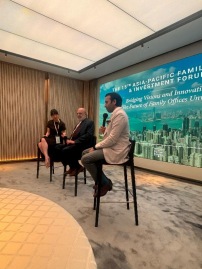
THE FAMILY OFFICE FRAMEWORK - CAPITAL WITH PURPOSE
The Chityalas structured their family office with a clear, mission-aligned thesis: philanthropy as a foundational goal, investment as an enabler, and knowledge as a multiplier. Over time, the family consolidated what was earlier dispersed across various investment vehicles and causes into a unified operating model. This shift enabled not just clarity in allocation, but also continuity in purpose.
“The family office was established with an intent to do something for the community— as an endowment and through charity—because we have benefited significantly over a period of time.”
The endowment philosophy began with a deep personal motivation. Having benefited from institutional careers and community support during thee migration journey of Sridhar Chityala and his wife, the family saw giving back not just as a moral imperative, but as a systemic response to growing inequality.
The family views capital through the lens of the “inverted pyramid”—a world where inclusion starts at the bottom rather than trickling down from the top. In this view, impact starts by enabling participation: access to healthcare, education, financial tools, and dignity in economic contribution. This framework shapes how both philanthropic and investment decisions are made.
Efforts include supporting underserved communities through targeted giving, funding school access for those without means, and empowering micro-entrepreneurs with tools to integrate into the formal economy. Requests coming into the family—from founders to nonprofits—are assessed based on their ability to catalyse long-term, scalable empowerment.
TOOLS, METRICS AND GOVERNANCE
For exclusive insights on investment trends, geopolitics, family office relevant themes and wealth preservation, follow Vedas Group Asia’s LinkedIn page
Beyond intention, structure and execution define the Chityalas’ approach. Whether in family budgeting or fund allocation, the operating model emphasises quantification. Every initiative—charitable or commercial—is managed with clear KPIs, tracked through tools and systems built for transparency.
“We are very quantitative. Everything in our household has a spreadsheet. If you cannot quantify something, you cannot measure it. And if you cannot measure it, you don't know where you are.”
The family office operates with tightly defined investment targets: aiming for 6–8% annualized returns, accepting downside to 4% and stretching to 10%+ where warranted. The focus is on capital preservation, risk-adjusted return, and adherence to a disciplined portfolio construction approach. Public markets are part of the mix, though the Chityalas stress their preference for direct and thematic exposure rather than index-style plays.
Tools play a central role in that mindset. Everything from household expenses to investment pipelines is managed on spreadsheets. “If you cannot quantify it, you cannot manage it,” was a recurring theme throughout the discussion. This applies as much to endowment tracking as to early-stage deal flow. The family expects that level of rigor across both philanthropic and commercial operations.
Their governance framework is equally tight. Learnings from decades in global financial institutions— JPMorgan, Commonwealth Bank, and others—have shaped a view that simplicity in capital strategy matters more than complexity. Capital allocation, risk management, and alignment with stakeholders
are the three anchors. Investment decisions are centralized across a small group, allowing agility without sacrificing oversight.
BUILDING THROUGH VENTURE
Outside the family office sits Vedas Group Asia, the family’s venture building and investment platform. While the family office is oriented around capital preservation and impact-driven philanthropy, Vedas Group focuses on high-growth opportunities in early- and mid-stage technology ventures across Southeast Asia, India, and global growth markets.
“We work in businesses that not only deliver financial outcomes but also demonstrate great societal impact.”
The thesis is shaped by firsthand experience in banking and technology cycles—from the dot-com boom to the rise of digital infrastructure in emerging markets. Investing began with a collaborative effort involving other family offices but has since evolved into a model where Vedas Group often leads deals, supports go-to-market strategy, and takes operational roles in portfolio companies.
Key focus areas include fintech, healthcare, data infrastructure, and AI—sectors that deliver both financial returns and measurable societal utility. One standout investment involves a digital payments platform that originated in India, targeting financial inclusion from the ground up. The platform enables same-day onboarding for informal vendors such as tea sellers and florists, while also serving large scale retailers. By eliminating middlemen and legacy frictions, the venture has scaled significantly, driven by regulatory tailwinds like India’s Aadhaar identity system and the Unified Payments Interface (UPI).
For exclusive insights on investment trends, geopolitics, family office relevant themes and wealth preservation, follow Vedas Group Asia’s LinkedIn page
“The idea was to democratize payments. Whether you're selling tea or flowers on the street—or a global retailer—you should be able to participate in the financial system. That’s why we invested early, almost nine years ago.”
Another venture, born from the family’s own challenges in emerging market diligence, now supports real-time decision-making in high-friction markets. Initially built to enhance pre- and post-investment workflows for family offices, the platform has grown into a data infrastructure provider with public sector utility—used, for example, to help governments plan COVID-19 responses based on digital footprint patterns.
Returns from these businesses are substantial—targeting 25–30%+ IRRs—but are always balanced with the requirement that they deliver a wider economic or social good.
BUILDING WITH FAMILIES
Partnerships with other families remain central to how both the family office and Vedas Group operate. The Chityalas engage with a network of aligned families, often with complementary strengths—geographic reach, domain expertise, or shared impact objectives.
But partnerships are built slowly—typically over 12 to 24 months—before any capital is deployed together. This allows the family to test alignment beyond investment theses: values, governance styles, and decision-making frameworks. Stakeholder roles are defined early, and in cases where divergence emerges, pre-agreed exit paths are activated.
The Chityalas emphasised that this isn’t a typical shareholder mindset; it’s a stakeholder ecosystem. Relationships are built around stewardship, and the goal is to scale impact through thoughtful co investment, not just syndication.
“This is not like shareholders. We’re all stakeholders. And with stakeholders, decisions rest with a small number, so alignment matters deeply.”
THE ROLE OF PUBLISHING
Unlike many family offices that operate under the radar, the Chityalas take a different approach— publishing regular blogs, hosting podcasts, and curating private conversations with other principals. The intent is not to assert “thought leadership” but to contribute meaningfully to an evolving global dialogue on capital, governance, and responsibility.
The initiative began with 50 families and has since expanded organically. Much of the commentary is data-driven—grounded in policy, geopolitical trends, and market shifts—and seeks to explore intersections between technology, investing, and global coordination.
“Giving something back based on your learning is part of our value system,” the family shared.
It’s also consistent with the office’s belief that transparency, humility, and shared insights can elevate the quality of decision-making across the family office ecosystem.
SYNTHESIZING LEGACY, INNOVATION AND STRUCTURE
For exclusive insights on investment trends, geopolitics, family office relevant themes and wealth preservation, follow Vedas Group Asia’s LinkedIn page
Whether through the lens of charity, venture creation, or governance, the Chityalas continue to evolve a model that integrates institutional clarity with human-centered outcomes. With a growing global presence, their work at the intersection of finance, community, and data-driven execution serves as an emerging blueprint for how modern family offices can operate—with precision, empathy, and ambition.